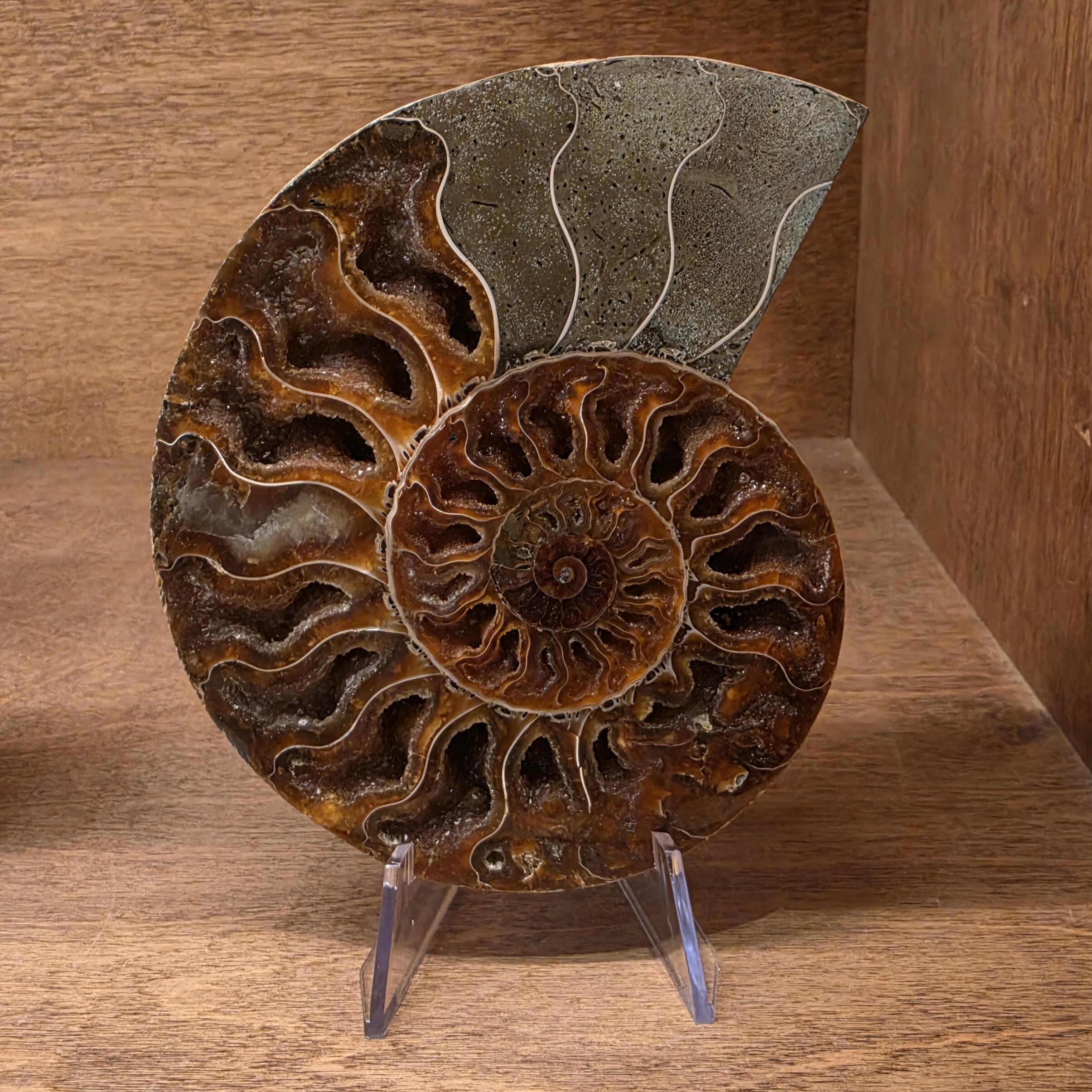
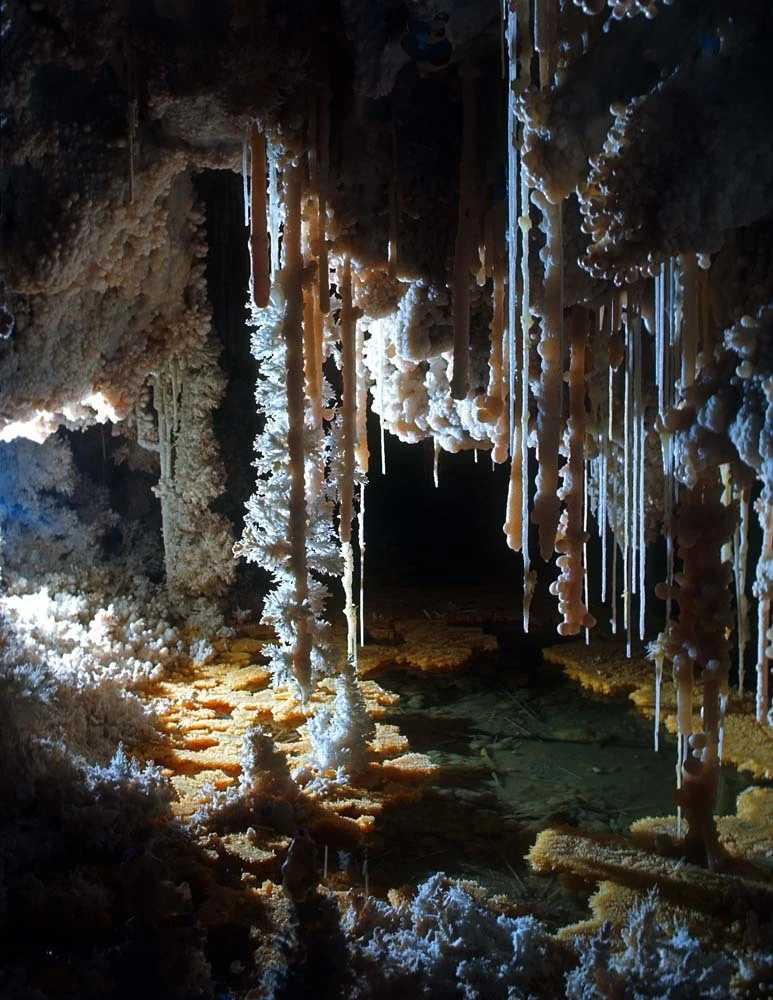
While doing some research on aragonite for a site listing, I discovered some interesting information about the mineral. Aragonite is almost nonexistent in Earth’s observable record prior to the Carboniferous Period about 359 million years ago. This seemed rather unusual and compelled me to keep digging into it. As it turns out, it is not likely that aragonite was absent from Earth until the Carboniferous, but rather it has changed forms. It has been found as early as 4.56 billion years old in meteorites1, but I wanted to focus more on our planet’s unique relationship with the mineral. Aragonite is a form of calcium carbonate (CaCO3) that is metastable near the Earth’s surface. This means that it is not favorable for it to exist but requires something else to push it to calcite which is more stable and common. Most of the aragonite we begin to see in the Carboniferous is biogenic, meaning originating from organic life. Around 350 million years ago, mollusk relatives began to shift from calcite-based shells to aragonite.2 Many of the ammonite fossils found in abundance have a blend of aragonite and calcite, with a significant amount of calcite formation starting from aragonite decay. After my preliminary research, I figured the majority of aragonite present must have been biogenic, or formed from pressurization of calcite bodies like you see in Morocco and Spain in their crystalline specimens. However, aragonite is still actively forming today. One of the easily observed examples of accumulating aragonite is at Carlsbad Caverns National Park in New Mexico. Here, the aragonite continues to accumulate because of magnesium. Without getting into too much heavy detail, magnesium interrupts the crystallization of calcite and causes aragonite crystallization instead. There are some more specific examples of this interaction that can be followed up on, such as magnesium use for aragonite seeding for reef systems. Perhaps I will do another write up on that in the future, but I was more interested in the geologic implications at the time of researching this. Links to the information I found are all listed below if you want to get lost yourself. Moroccan Aragonite Specimens by the Millions — Rock & Gem. Communications Earth & Environment article (2025). The Role of Magnesium in the Crystallization of Calcium Carbonate — Journal of Sedimentary Research. [2] Calcitic Shells in the Aragonite Sea of the Earliest Cambrian — ResearchGate. [1] Springer article (2015), DOI: 10.1007/s13146-015-0257-2. Ammonite Fossil with Calcite Crystals Aragonite Room — Carlsbad Caverns, New MexicoAragonite: A Mineral with a Changing History
References
Image Credits
Photograph: Teton Minerals & Mercantile.
Photograph: Carl Kunath. Source: Texas Speleological Survey, Speleothems.
