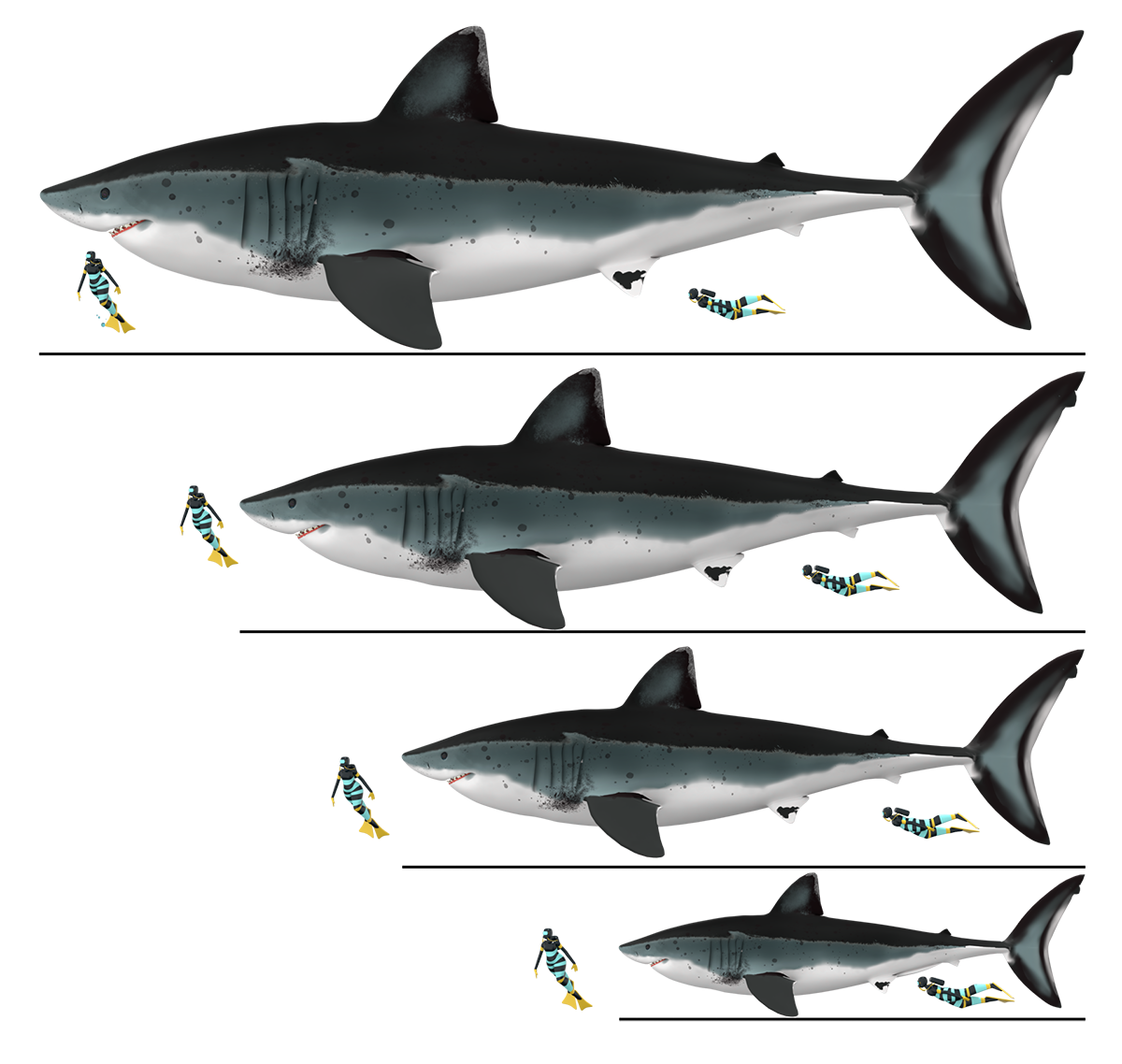
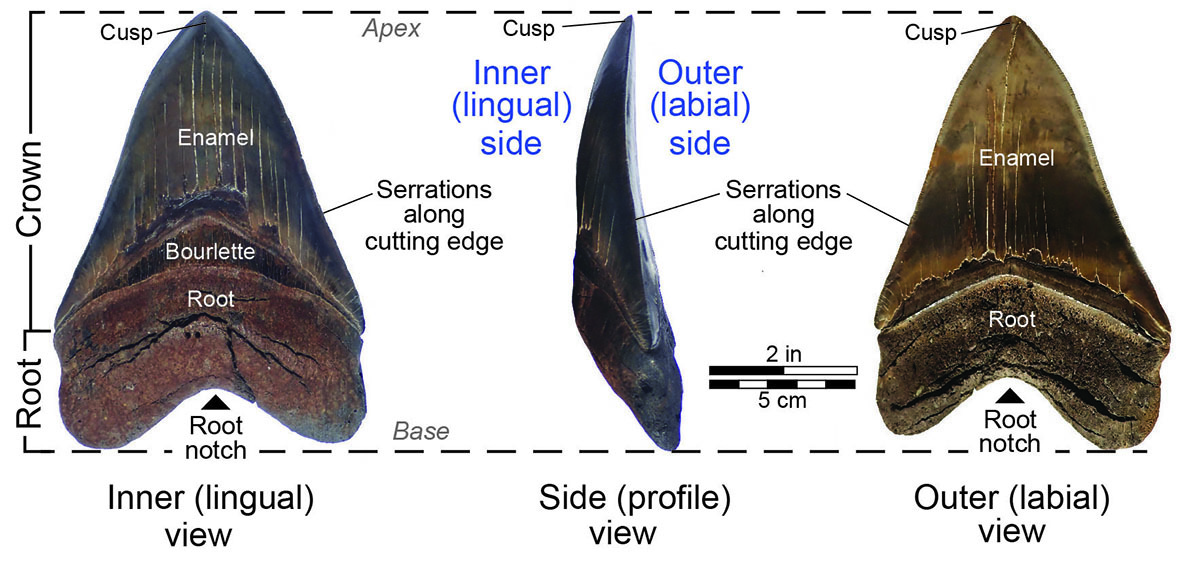
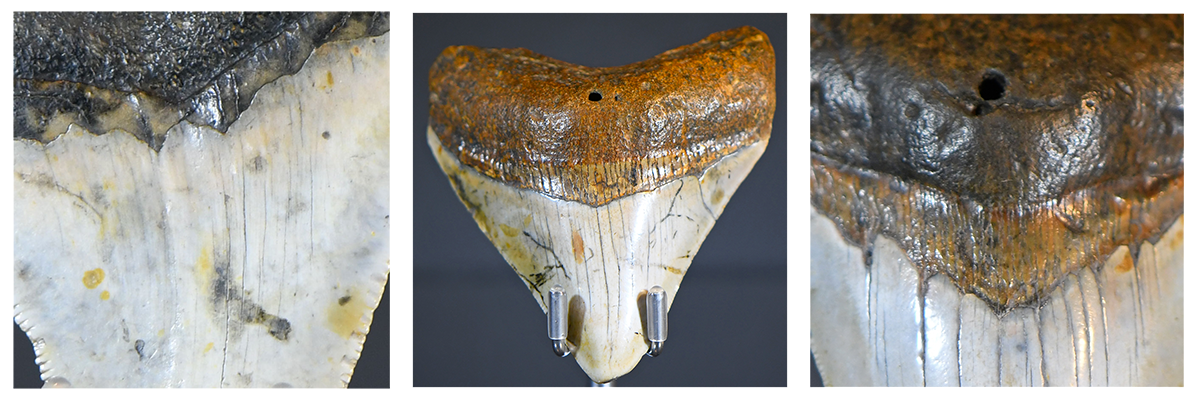
One of the most fearsome predators to ever swim in the ocean, Otodus megalodon was a massive prehistoric shark from the Miocene and Pliocene epochs (~23-3.6 million years ago). These creatures had streamlined bodies to move through the water easily, cruising long distances much like the sharks of today. An adult female is estimated to have measured 50-70 feet in length, weighing as much as 50 tons. Males were smaller, measuring an estimated 34-47 feet and weighing around 30 tons or less depending on size. Megalodon inhabited oceans across most of the globe, apart from polar regions. Juvenile megalodon primarily lived close to the shoreline until they matured, with adults moving towards deeper ocean waters. Their diet consisted of larger sea life, including whales, turtles, dolphins, seals, and even other sharks. Whale fossils have been found with scratch marks and even tooth fragments from megalodon teeth! Paleontologists draw these conclusions from the limited fossil record available for megalodon. Much like today’s sharks, their skeletons were made up of cartilage, which does not fossilize well. Most of what we know comes from their teeth and their vertebrae. Recent research using nearly complete and partial vertebral columns found in Belgium and Denmark has helped us learn more about their size and shape. Megalodon teeth make up most of the fossil record available for this incredible species, with this giant shark going through up to 40,000 teeth in a lifetime. Sharks produce teeth continuously, going through a set of teeth every one to two weeks depending on their diet, littering the ocean floor with teeth. Teeth are also the hardest part of the skeleton, composed mostly of calcium phosphates which degrade slowly and readily take to mineralization. These teeth can vary greatly in size, with the average adult tooth measuring 3-5 in (7.6 – 12.7 cm) in slant height. Slant height is the longest distance from the tip of the tooth to the end of the root, following the diagonal “slant”. The largest tooth ever recorded came from Peru, measuring a slant height of 7.48 in (19 cm)! You may notice, among fossil megalodon teeth, a wide variety of patterns and colors. During the fossilization process, teeth and bones take on secondary minerals through replacement and substitution. These minerals contribute to different colors; for example, deposits with lots of phosphate typically produce black teeth, whereas significant iron deposits contribute to reds and oranges. Occasionally, blue/green megalodon teeth are found, typically where there is a high concentration of glauconite. Sometimes you will see the crown and the root of the tooth have significantly different colors. The enamel crown is a much harder material and far less porous than the root, allowing changes in the mineral composition to have a more pronounced effect on the color of the root in a short period of time. Some teeth will have secondary staining associated with biological activity. Orange spots can occur when marine life attaches to the tooth and secretes digestive acids that react with the calcium in the enamel. This can cause small divots in the enamel if enough acid builds up. Black streaks or lines are another common pattern found on teeth, resulting from worms or other organisms decaying on the teeth. This decay creates an anaerobic (oxygen-free) environment for bacteria. These bacteria can create secondary iron sulfide mineralization, contributing to the black coloration. The holes in tooth roots are usually caused by marine organisms such as moon snails, boring clams, and whelks. Megalodon teeth are not particularly rare but can be very valuable if certain criteria are met. Tooth fragments and partial teeth are the most abundant, but discerning the value of fully intact teeth can be more challenging. The most important factors are size, condition, and repair. The value of a megalodon tooth is incredibly dependent on the size. A 2–3-inch tooth can cost $50-$150, whereas a 6-inch tooth will easily be in the thousands. A 6-inch tooth can be more than double the price of a 5.8-inch tooth due to the scarcity. Intact megalodon teeth above 7 inches will likely be in the tens of thousands as they are exceedingly rare. As mentioned earlier, megalodon teeth are measured by slant height, or the longest diagonal from root to tip. The condition of a tooth can be just as important as the size. Starting with the root, an ideal megalodon tooth will have a distinct notch with two lobes. Minor erosion is generally acceptable, but having significant wear or missing chunks can impact value. Next, examine the enamel crown. Megalodon enamel is prone to peeling, sometimes looking like a strip was pulled off the tooth. Significant amounts of peeling can reduce the value of a tooth, even if the rest of the tooth is intact. Serrations should run along both sides of the tooth. Because of damage during feeding and subsequent erosion, particularly in ocean finds, having serrations all the way to the tip is rare. Missing serrations entirely can also be a possible sign of polishing or alteration. Also keep an eye out for chipping along the sides. Small chips are common, so having no chips at all can increase the value of a tooth. Last is the bourlette, the strip between the blade of the tooth and the root. It is often slightly glossy when intact, but it is uncommon for the bourlette to be intact across the whole tooth. Bourlettes frequently show wear or are worn down entirely. A fully intact bourlette can increase the tooth’s value. Repairing a tooth usually refers to having one or more broken segments that are adhered back together with glue. This is something that can usually be seen using UV light as many glues used in the industry glow a bright neon blue/white. Restoration refers to adding pieces of the tooth that were missing. This can be at the root, either adding missing segments or replacing it entirely to make the tooth appear whole. Some skilled workers can do enamel repairs as well, reconstructing portions of the enameloid crown that blend seamlessly with the original. UV light is another useful tool as replaced enamel usually won’t react. This is not a guaranteed way to detect repairs or restoration, but can be helpful. Repair and restoration decrease the value of the tooth; however, an altered tooth is still considered an authentic fossil. Unfortunately, many people will not declare repair or restoration, especially on larger, more valuable teeth. Asking questions about authenticity is always a good idea, and honest dealers will be happy to assist you. While we do not know the exact time the last megalodon died out, evidence suggests all megalodon were extinct by the end of the Pliocene Epoch, with the last traces from 3.6 million years ago. Studies from 2022 indicate that smaller sharks, such as the great white shark, competed with megalodon for food, compounding the struggle. This coincides with a period of global cooling, expanding glaciers and falling sea levels. The cooler ocean temperatures shrank the available range as megalodon thrived in warm waters. Lower sea levels caused a loss of megalodon nurseries while also pushing young sharks towards deeper waters, where they were susceptible to predators. These factors may have contributed to the demise of the species. While there are myths that megalodon still exist, there is no significant evidence of this being true. We have not seen visual evidence of a shark being this large, nor have there been fresh traces of megalodon bite marks or fallen teeth. The youngest recorded tooth dates to 3.6 million years ago. Others believe megalodon may still be living in the depths of the ocean, but this is extremely unlikely as food sources become incredibly scarce below 3,000 meters (9,800 ft) and the cold temperatures would not be suitable.Megalodon: Giant of the Ancient Oceans
What is a Megalodon?
Megalodon Teeth
Megalodon Tooth Colors
Megalodon Tooth Markings
What do you look for in a tooth?
Size
Condition
Repair/Restoration
What happened to the Megalodon?
Could the Megalodon still exist?
Citations
