


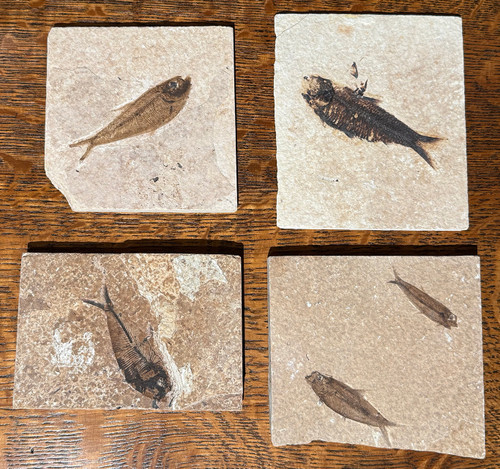
Small mini fish fossils from the Green River Formation. These small specimens are typically juvenile Knightia or Diplomytsus. The fossils are typically 2½ - 4 inches, with an overall plate size of about 3½ - 5 inches on a side. Some plates will have two smaller fossil fish. The photographs show the typical size and quality of these fossils, but are only representative. The fossil you will receive will be unique and not one of those shown. These make great treasures for kids, beginning collectors, or simply as fascinating gifts of the earth from a bygone era.
Formation/Age: Green River Formation, Eocene (~50 Million years)
Locality: Kemmerer, Lincoln County, Wyoming, USA
Fossil Lake Information
Fifty million years ago ancient Fossil Lake existed in what is now Southwest Wyoming. Of its estimated maximum extent of 930 square miles, approximately 500 square miles of sediments remain. The 230 square miles across the center of the ancient lake bed contain exceptionally fossiliferous sediments and associated geologic features including deltas, beaches, springs, and rocks from center to near shore environments.
The unusual chemistry of Fossil Lake prevented decay and scavenging of dead organisms, while millimeter thick layers of alternating limestone and organic matter slowly accumulated. The resulting laminated limestones contain the highest concentration of articulated fossil fish in the world. The fish, and other fossilized aquatic organisms, and associated geologic features make Fossil Lake the world's best Paleogene record of a freshwater lake ecosystem.
Since its discovery in the 1870s, more than a million perfectly preserved fossil fish have been recovered. Preserved with the fish in the laminated limestone is a complete ancient aquatic ecosystem: cyanobacteria, plants, insects, crustaceans, amphibians, alligators, turtles, birds and mammals, including the oldest pantolestid (otter-like animal). The subtropical terrestrial ecosystem surrounding the lake is also represented by rare fossils, including a horse, two snakes, lizards, two bat species, birds, and more than 325 types of leaves, seeds, and flowers.


