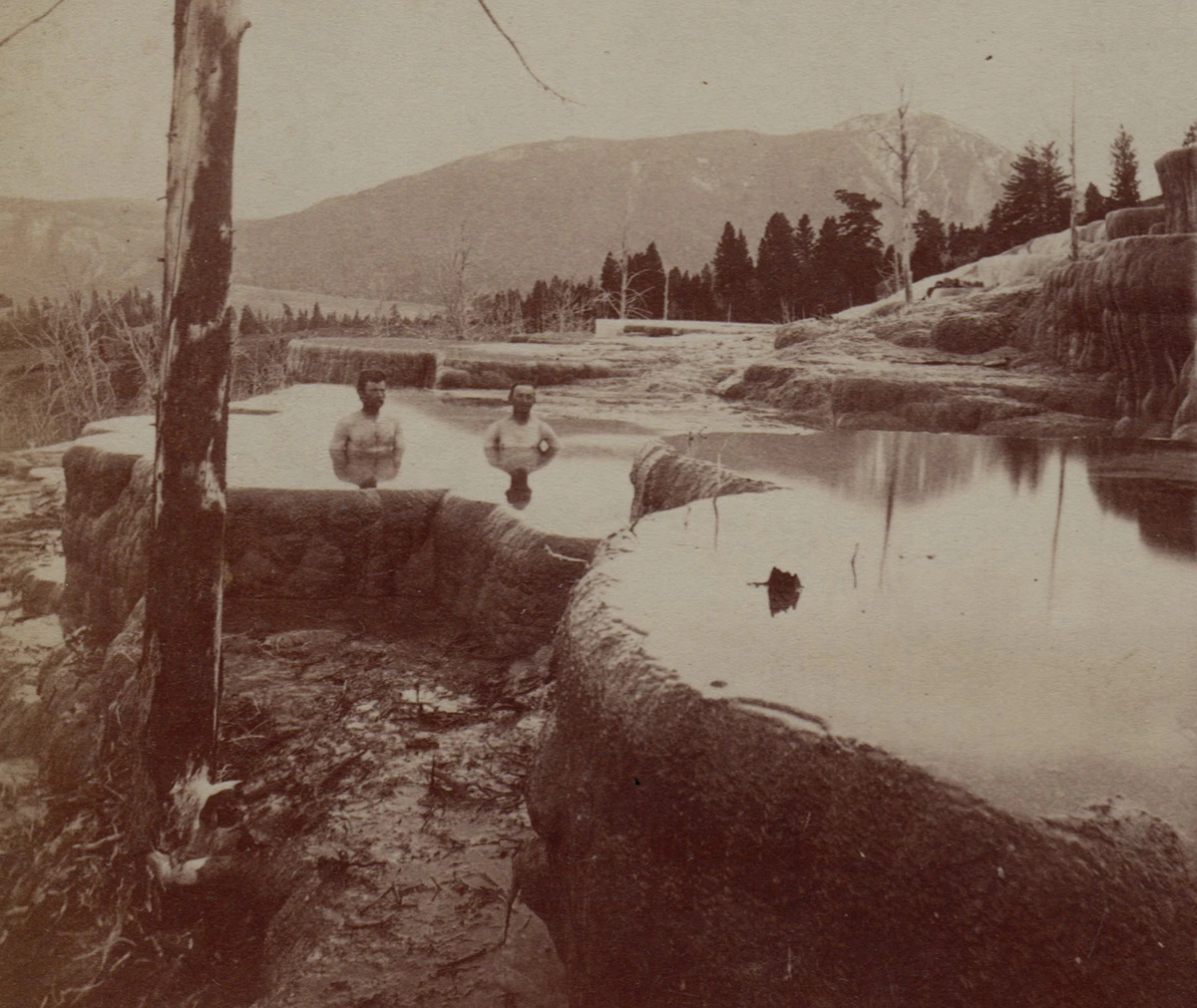
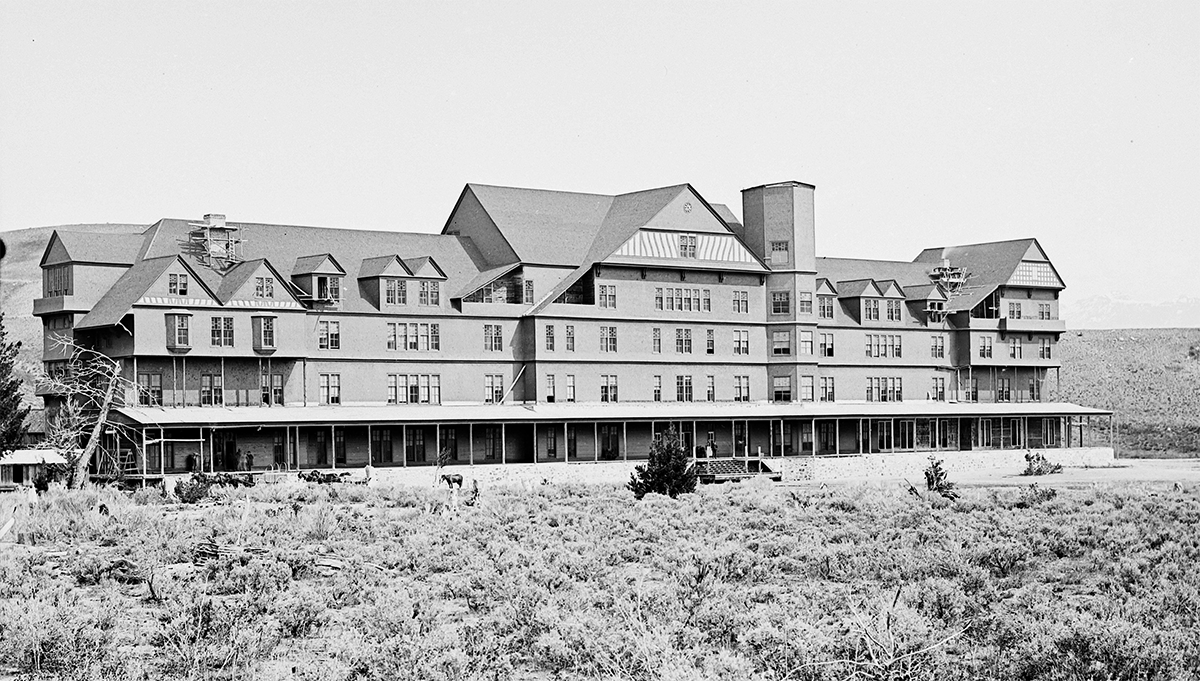
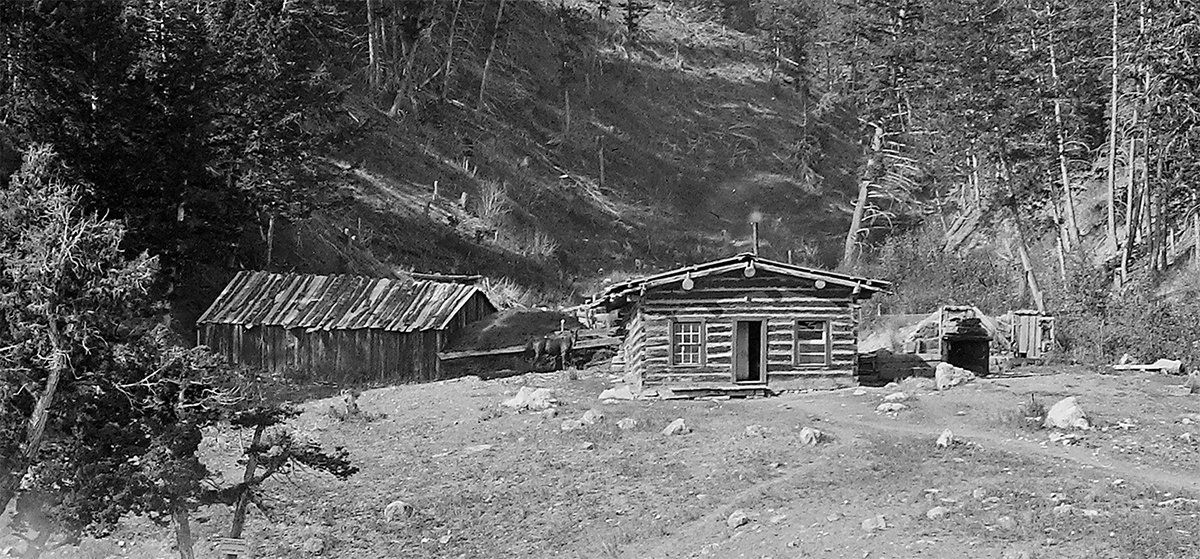
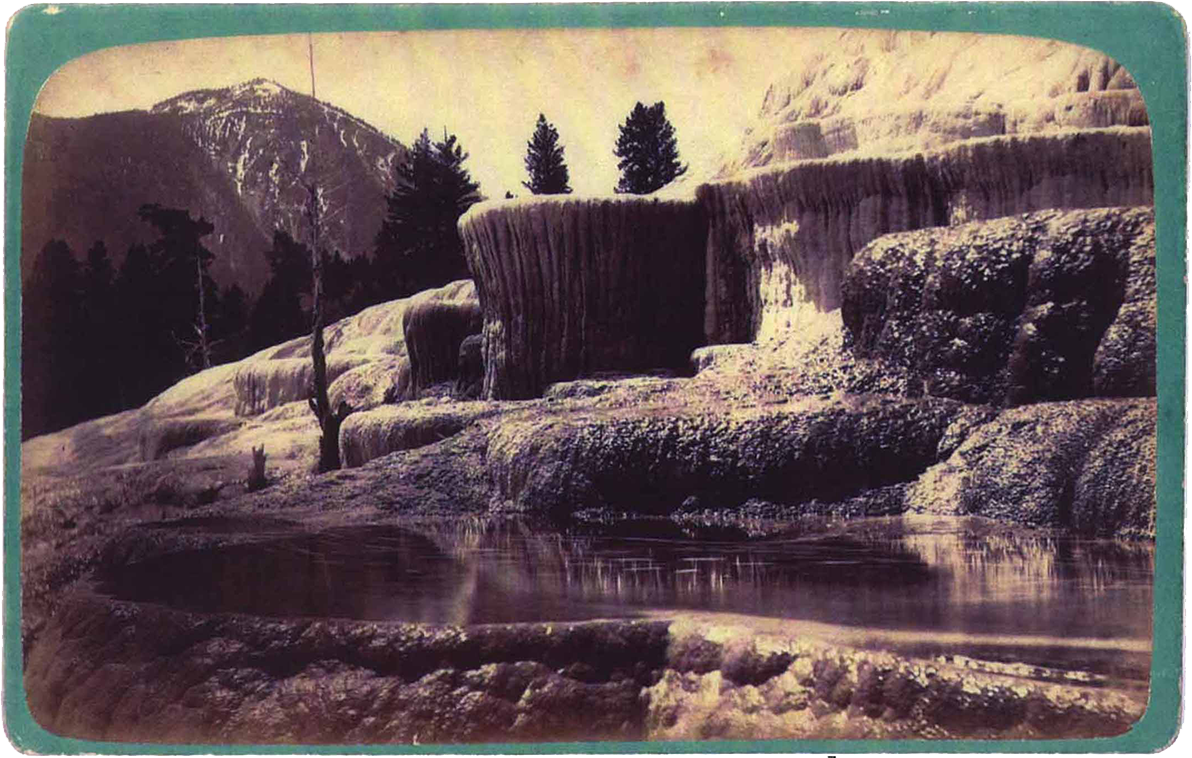
Today, taking a relaxing bath in the natural travertine pools of Mammoth Hot Springs in Yellowstone National Park is unthinkable. For more than a century, walking on delicate geyser and spring formations has been prohibited. But was it always so? In 1883, Yellowstone photographer Frank J. Haynes published a small souvenir book, Yellowstone National Park. It features a selection of his photographs printed as lithographs. In those days, printing photographs in publications was difficult and expensive. Most were first converted into woodcuts, engravings, or lithographs by an artist. We explore Haynes’ lithographic works in our book, Souvenir Yellowstone National Park: The Lithographic Souvenir Albums of F. Jay Haynes. In Haynes’ lithograph Mammoth Hot Springs Formation, there appears to be a man bathing in a pool. In researching Haynes’ lithographs, we searched for original source photographs provided to the artists of the Louis Glaser company of Leipzig, Germany, creator of Haynes’ lithographs. We learned that while the artists rendered Yellowstone’s physical features very accurately, they took artistic liberties with people, often adding or removing them from a scene. For Mammoth Hot Springs Formation, we were curious whether there was, indeed, a photo with a man in a pool. Regrettably, we were unable to locate the original photograph. But we did locate Haynes photographs showing staged scenes where a man appears to be soaking in a pool. He’s not actually in the pool, but is instead standing outside, behind the formation. In 1251 Formation at Mammoth Hot Springs, the man’s arms are outstretched in the same manner as the figure in the lithograph. Checking scientific sources revealed that water temperatures at Mammoth Hot Springs are generally around 160° F, far too hot to soak in. With temperatures that high and finding only photographs of people in the springs being clearly staged, we concluded that the figure in the lithograph was a fanciful addition. The springs are just too hot to bathe in. A big challenge in writing about history is not knowing what you don’t know. With our focus on the photographs of F. J. Haynes and the fact that Mammoth Hot Springs are very hot, it was reasonable to assume people couldn’t bathe in the pools. After we published our book, I continued researching early Yellowstone history and photographers. Henry Bird Calfee was part of the first generation of Yellowstone photographers, primarily active in the 1870s. He was based in Bozeman, Montana (Montana Territory at that time) and produced a significant portfolio of Yellowstone images. While viewing his photos, I stopped in amazement at No. 13. Cleopatra’s Bath. Could it be? This photo clearly shows two men bathing in a pool at Mammoth. It’s not staged like the Haynes photos. Uh-oh. People could, and did, bathe in the pools at Mammoth Hot Springs! I like reading first-person accounts when researching history. They allow me to be close to the person who experienced it and reach my own conclusions. I was pleased to acquire Yellowstone, Land of Wonders: Promenade in North America’s National Park. In 1883, Belgian travel writer Jules Leclercq visited Yellowstone National Park. He published an account of his adventures in 1886. Written in French, it was not fully translated into English until the publication of this book in 2013. Leclercq shares his experience at Mammoth Hot Springs and touches on the beliefs of the day that natural springs had therapeutic value: The Mammoth Springs thermal waters have been known for too short a time and are not yet sufficiently analyzed for their healing virtues to have been tested. They do seem to be effective for skin ailments and rheumatic diseases. Perhaps one day the sick will hasten from all parts of the world to bathe in these beneficial springs. While enjoying a fine bath, Leclercq discovers the changing nature of the springs: I experienced the supreme satisfaction plunging into a basin whose waters were an exquisite 30° C [86° F]. My bath was a meter deep. The siliceous efflorescence that lined the interior walls seemed like velvet cushions. I remained perfectly still for a long time in the delightful bath, allowing my body to be pervaded by the invigorating influence of those waters, gentler to the skin than the softest comforter and as agreeable to the taste as to the touch. While I was reveling in my bath, I became aware of the augmentation in water level following a sudden rise in level in a higher spring, and to my great horror, I noticed a neighboring basin that had been completely dry was now flooded by the rise. Now, it was in that basin that I had put my clothes, my boots, my towels. One must have suffered a similar ordeal to understand what deep despair can arise from the smallest accidents. The proximity of the hotel consoled me in my misfortune. The hotel Leclercq refers to is the National Hotel. It first opened in August 1883, the same year that the Northern Pacific Railroad completed its branch line to Cinnabar, which was just north of present-day Gardiner, Montana. Leclercq was a guest of both the railroad and the hotel in their inaugural year. Today’s Mammoth Hot Springs Hotel sits essentially on the site of the National Hotel. A few years earlier in July 1879, S. Weir Mitchell, M.D., visited Yellowstone in a time before train service or any real accommodations. James McCartney’s small log structure, the Pioneer Hotel, was all there was at Mammoth, and by just about anyone’s standards, it wasn’t much of a “hotel.” In 1878, F. V. Hayden made another expedition to Yellowstone, describing the accommodations as primitive, with no beds, where “every guest is expected to provide his own blankets.” The fare was equally simple, “remarkable for quantity rather than quality or variety.” Traveling with a military contingent from Fort Ellis, Montana Territory, Mitchell shares a similar experience when visiting Mammoth Hot Springs. Leclercq wasn't the only visitor whose bath ended with an unexpected soaking of his belongings: With hundreds of gleaming bath-tubs full of water from 180° Fahrenheit down to 75°, the temptation to hot and tired men to bathe was delicious, and the only trouble lay in the difficulty of choosing our place. Finally, we set our hearts on a noble tub about three feet deep and eight in diameter. My friend, being neat in his ways, much rejoiced over the little dry basins about us, which he called dressing-tables. In one he put his brushes, in another a battered hat; in one soap and sponge, in another clean towels; and so on, with little cleanly nests for shoes and clothing worn or to be worn. His satisfaction was immense, and I was obliged to find accommodation farther away. Then we slipped into a bath at 85° Fahrenheit, cushioned with soft silicates, and so absolutely delicious that we sank for a few moments into motionless, silent enjoyment. Presently my friend uttered words which I may not repeat, and looking up, I saw that the springs above us had been seized with a fit of prodigality, and had suddenly and liberally overflowed the doctor's dressing-tables. His visage as he got out of the bath with alacrity was something to remember. Camping overnight at Mammoth, Mitchell used the “bath-tubs” again the next day: … I descended a little and found another bath, pleasantly cool enough, owing to the remoteness of its parent spring. The edges were copper-yellow, much mottled, and the water clear and tasteless. I presently lay in this delicious bath, whence I could look up at the sombre mountain-pines, and down over the terraces blur-red with steam or gleaming with the colors of their hundred pools. Lower yet, the white faded to gray, and melted into the dull green of the dry valley-grasses, the glancing river far away, the dark-green cleft of Gardiner River Canon, and ringed around the distant horizon mountain over mountain far as eye could see. Not many bath-rooms on earth possess such a picture-gallery as this. After a pipe or two in my unique bathing-pool I dressed and wandered back to the pine-clad slopes of the mountain above. So there we have it: firsthand accounts of bathing in the pools of Mammoth. Today, we can only dream of luxuriously lounging in the pools of Mammoth Hot Springs, looking out over the valley below. It’s a pleasant fiction to imagine entering the pools of Diana’s Bath, shown in another H. B. Calfee photograph. (Calfee called this location Cleopatra’s Bath on the No. 13 photo and it is also known as Pulpit Terrace.) Hayden, F. V. Twelfth Annual Report of the United States Geological and Geographical Survey of the Territories. Part II. Washington, DC: Government Printing Office, 1883. Haynes, F. Jay. Yellowstone National Park. Souvenir album. Fargo, Dakota Territory: F. Jay Haynes, 1883. Leclercq, Jules. Yellowstone, Land of Wonders: Promenade in North America's National Park. Translated and edited by Janet Chapple and Suzanne Cane. Lincoln: University of Nebraska Press, 2013. Originally published in French as La Terre des Merveilles: Promenade au parc national de l'Amérique du Nord (1886). Mitchell, S. Weir. “Through the Yellowstone Park to Fort Custer.” Lippincott’s Magazine of Popular Literature and Science 25 (June 1880): 688–704. Schellhase, Brent, and Ryan Schellhase. Souvenir Yellowstone National Park: The Lithographic Souvenir Albums of F. Jay Haynes. Teton Minerals & Mercantile, 2025. Whittlesey, Lee H. “‘Everyone Can Understand a Picture’: Photographers and the Promotion of Early Yellowstone.” Montana: The Magazine of Western History 49, no. 2 (Summer 1999): 2–23. Whittlesey, Lee H. Yellowstone Place Names. Wonderland Publishing Company, 2006. 1251 Formation at Mammoth Hot Springs – 1882 – F. Jay Haynes No. 13. Cleopatra’s Bath – Likely 1870s – H. B. Calfee National Hotel – 1884 – F. Jay Haynes The Pioneer Hotel – McCartney Cabin – 1882 – F. Jay Haynes Diana’s Bath – Likely 1870s – H. B. CalfeeWhen We Bathed in the Pools of Mammoth Hot Springs
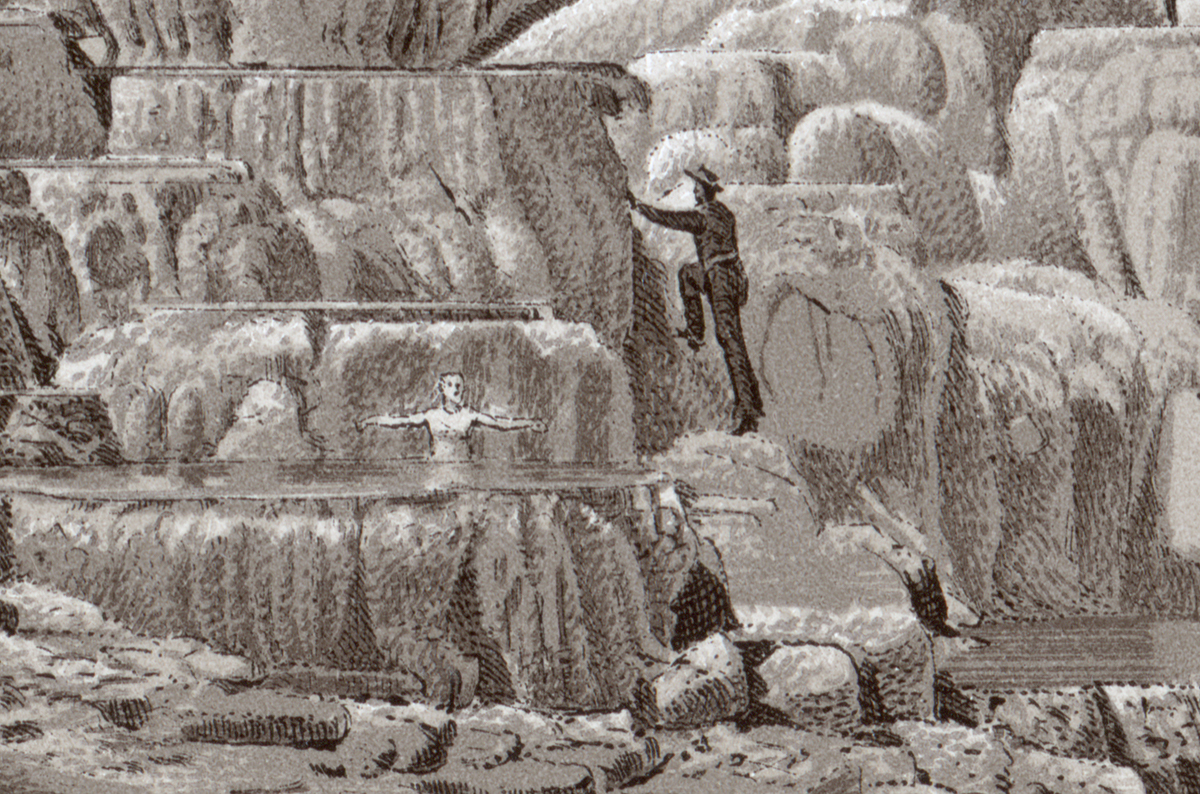
Lithograph – 1883 – F. Jay Haynes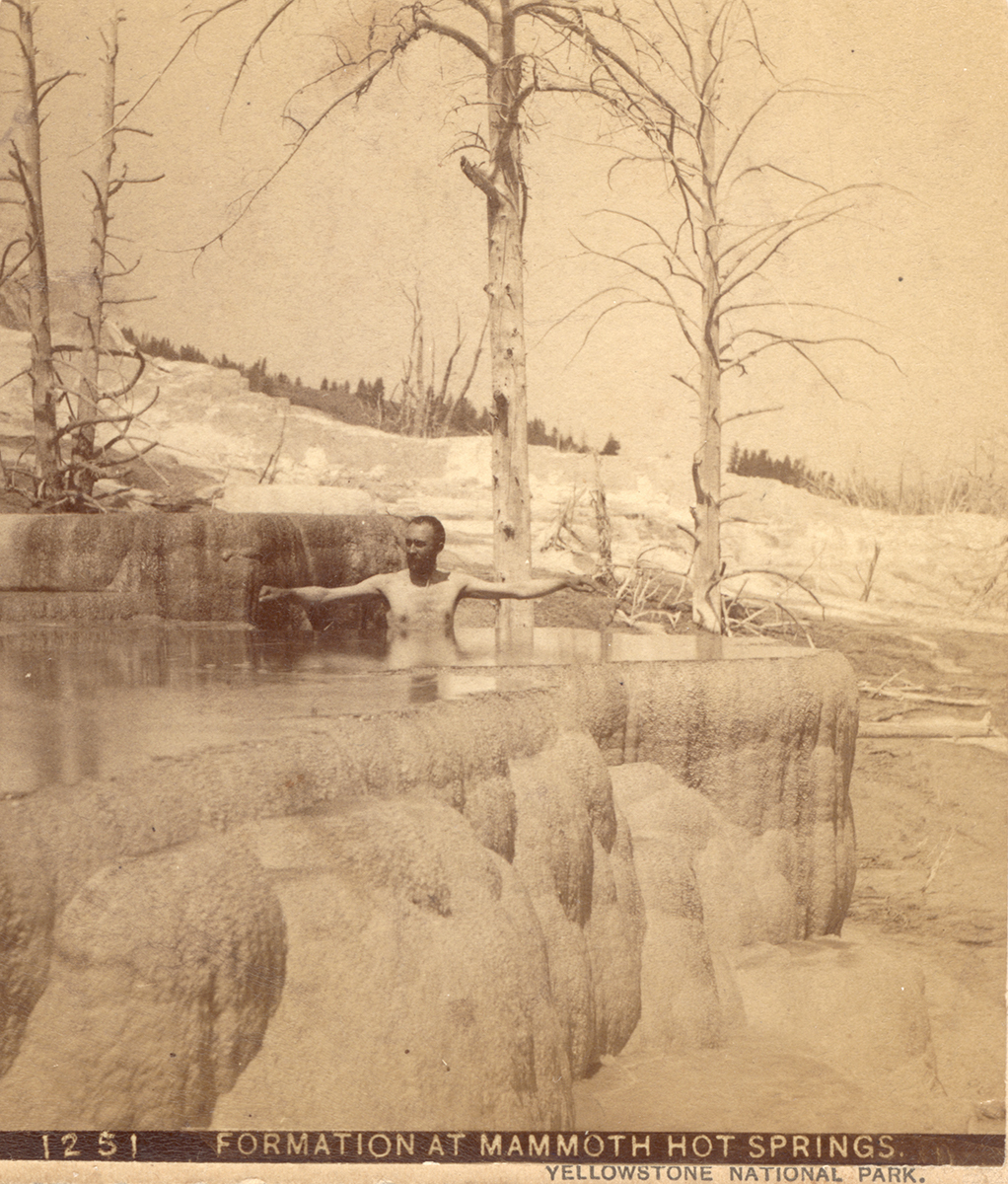
My Discovery of H.B. Calfee’s Photograph No. 13
References
Image Credits
Stereoview card, 1251 FORMATION AT MAMMOTH HOT SPRINGS. Published by F. Jay Haynes, Fargo, D.T.
Stereoview card, The Enchanted Land; or, Wonders of the Yellowstone National Park series. Image source: YellowstoneStereoviews.com.
National Hotel (front) from S.E. Mammoth Hot Springs, YNP. Montana Historical Society Research Center, Photo Number H-01450.
The Pioneer Hotel (McCartney’s Cabin erected in 1871), YNP. Montana Historical Society Research Center, Photo Number H-00717.1.
Non-stereoscopic photograph card. Image source: YellowstoneStereoviews.com.
